
The Arden Digest — Nov 12, 2026
A curated digest.
Adobe unveils Photoshop 2027 with a host of new AI features
@CreativeBloq · creativebloq.com ↗
Adobe's Photoshop 2027 update represents one of the company's most ambitious leaps in AI-powered tooling yet, promising to strip away the repetitive, time-consuming tasks that have long defined professional image editing workflows. The new AI features appear designed to handle the mechanical heavy lifting — selections, masking, retouching, and repetitive adjustments — so that artists can focus on creative decisions rather than execution. This continues a broader trend Adobe has been pushing across its Creative Cloud suite, embedding generative and assistive AI deeply into its flagship tools. For everyday users and working professionals alike, the update signals that the gap between creative intent and finished output is narrowing rapidly.

Adobe wants an AI agent to do your Premiere Pro editing
@CreativeBloq · creativebloq.com ↗
Adobe revealed a new Creative Agent for Premiere Pro at its annual Adobe Max conference, aiming to automate the most tedious parts of the video editing process. The agent is designed to handle tasks like rough cuts, clip organization, and other time-intensive grunt work that editors typically have to slog through before the real creative work begins. This follows a wave of AI-assisted editing tools flooding the market, but Adobe's deep integration into professional workflows gives its approach particular weight. The goal isn't to replace editors but to free them from the drudgery, letting human creativity take center stage once the boring jobs are out of the way.

Edit Animation Curves Directly In Viewport With This Free Blender Tool
80.lv · 80.lv ↗
A new free tool for Blender allows artists to edit animation curves directly in the 3D viewport, eliminating the need to constantly jump into the Graph Editor to tweak F-curves by hand. For animators, this kind of workflow friction reduction can be a genuine time-saver, keeping creative momentum intact without breaking immersion in the scene. The Graph Editor, while powerful, can feel clinical and disconnected from the actual animation playing out in 3D space — this tool bridges that gap. Being free lowers the barrier to entry significantly, making it an easy addition for Blender animators at any level looking to tighten up their process.

Adobe’s AI experiments let you walk around in photos and interview your characters
Jess Weatherbed · theverge.com ↗
Adobe's "sneaks" at Adobe Max offered a glimpse at some genuinely novel experimental features that push the boundaries of what's possible with static images and digital characters. Among the highlights: a tool that lets users virtually walk through a photograph as though it were a 3D space, and another that enables creators to have interactive, conversational interviews with their own illustrated or designed characters. These sneaks are Adobe's way of surfacing research-stage concepts to gauge audience interest, meaning they may or may not make it into actual products. Still, they offer a compelling window into where AI-assisted creativity could be headed — blurring the lines between still imagery, storytelling, and interactive media.

How To Build Stylized 3D Alpine Cottage Environment
80.lv · 80.lv ↗
Artist Eloi Landes has shared an in-depth breakdown of his French Alps Chalet project, a stylized 3D environment inspired by the traditional mountain architecture of his home region. The piece involved a carefully considered combination of stylized sculpting, hand-painted textures, and atmospheric lighting to evoke the cozy, weathered character of an alpine cottage. Landes' approach leans into the expressive potential of stylization rather than chasing photorealism, allowing the hand-crafted quality of the textures to give the scene a warmth and personality that hyper-realistic renders sometimes lack. The breakdown offers valuable insight for environment artists interested in developing a cohesive visual language rooted in real-world cultural and architectural references.
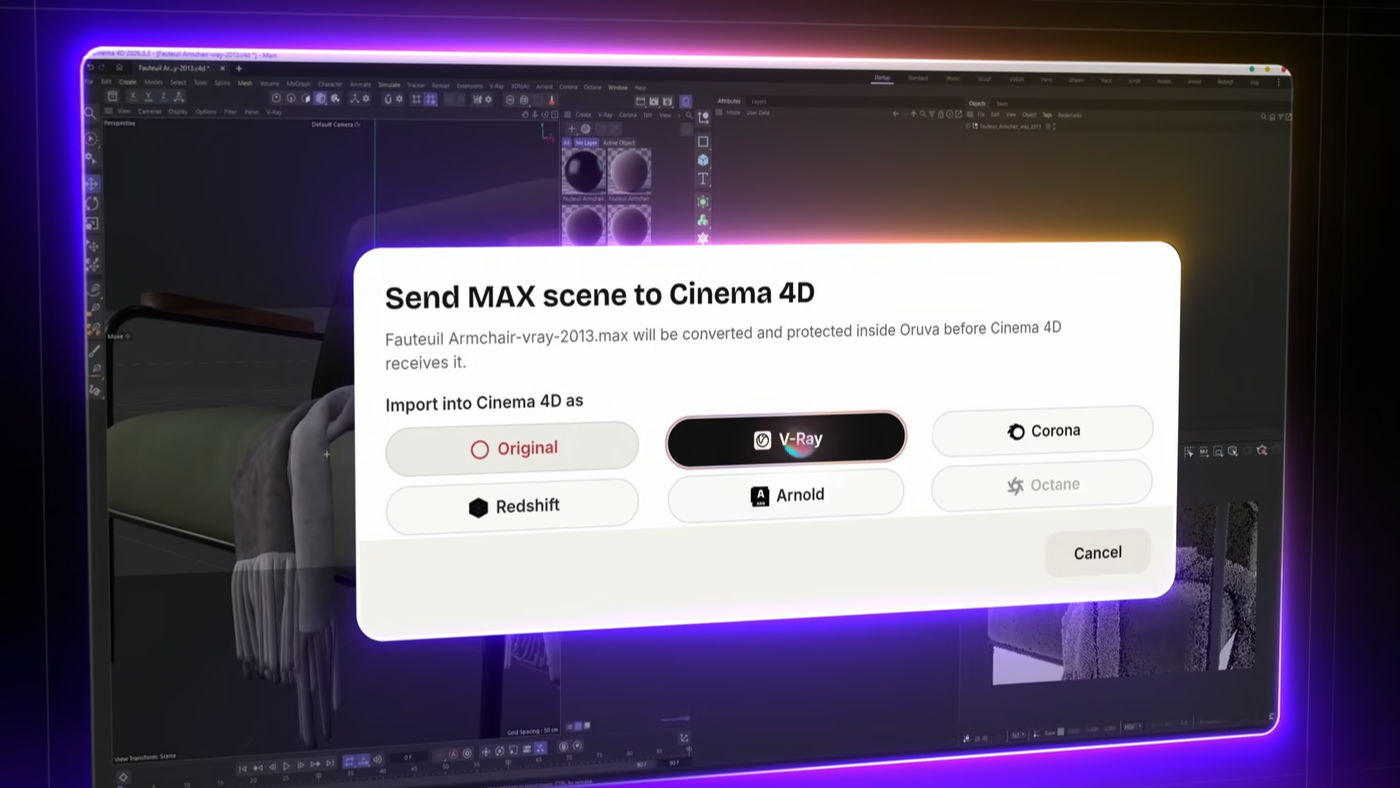
Oruva imports Max files into other 3D apps and converts materials
CGPress · cgpress.org ↗
Oruva is a newly launched Windows application that solves a long-standing headache in the 3D industry: getting assets out of Autodesk 3ds Max's proprietary .max file format and into other applications. The software reads native .max files and converts them into usable scenes in other 3D packages like Cinema 4D, including material translation — one of the trickiest parts of any cross-application pipeline. For studios and freelancers working in mixed-software environments, or inheriting legacy assets from clients who use Max, this kind of bridge tool can be enormously valuable. It addresses a gap that has persisted for years due to the closed nature of the .max format, which has historically required a licensed copy of 3ds Max to open.

Phone Cam Controller: a free phone virtual camera for Blender
BlenderNation · blendernation.com ↗
Motionist.studio has released Phone Cam Controller, a free Blender add-on that transforms an iPhone into a fully functional handheld virtual camera for navigating and capturing within the Blender viewport. The add-on streams the Blender view to the phone and uses the device's physical movement to drive the camera, giving animators and scene artists a tactile, intuitive way to explore their 3D environments. This kind of embodied camera control can be especially useful for previsualization and cinematography work, where feeling the movement in your hands produces more natural results than mouse-driven navigation. An Android version is reportedly in development, which will broaden accessibility considerably once it arrives.

The indie game community is in disarray over AI and Big Walk
Jay Peters · theverge.com ↗
The indie game development community is experiencing significant internal tension over the use of generative AI in games, brought to a head in part by debates surrounding the Independent Games Festival and a game called Big Walk. Some IGF jurors have publicly stated they will not vote for games that incorporate generative AI, drawing a sharp line in the sand at one of the most respected institutions in independent game recognition. The dispute reflects a wider cultural fracture within creative communities about authorship, labor, and the role of AI-generated content in work that is celebrated for its human artistry and vision. The outcome of these debates could have lasting implications for how festivals, publishers, and audiences evaluate and legitimize AI-assisted game development going forward.

Arkivism Is an Accessible Antidote to AI with 4 Million+ Public Domain Images
Grace Ebert · thisiscolossal.com ↗
Arkivism is a newly launched public domain index that aggregates over four million images, illustrations, photographs, videos, and other media from dozens of institutional archives into a single searchable platform. The project positions itself as an accessible, ethically grounded alternative to AI-generated imagery, offering creators a vast well of historical and cultural material that is free to use without licensing concerns. Public domain resources of this scale have always existed in scattered form across libraries and museums, but Arkivism's value lies in centralizing and making that material genuinely discoverable. At a moment when debates over AI training data and creative ownership are intensifying, a well-organized public domain repository feels both timely and necessary.