
The Arden Digest — Oct 8, 2026
A curated digest.
ComfyUI gets an AI agent
CGPress · cgpress.org ↗
Comfy has launched an AI agent for ComfyUI, its popular open-source, node-based platform used for building generative AI workflows. The new Comfy Agent is designed to plan, build, and presumably troubleshoot workflows on behalf of users, lowering the barrier to entry for a tool that, while powerful, has long demanded a degree of technical fluency. By embedding an AI assistant directly into the platform, Comfy is effectively letting the software configure itself in response to user intent. This move reflects a broader trend of AI tooling becoming self-referential — using AI to help users operate AI. For the large community of artists, developers, and researchers who rely on ComfyUI for image and video generation pipelines, an intelligent agent layer could dramatically accelerate experimentation and reduce setup friction.

Quadify: clean quad retopology for AI, scan and CAD meshes in Blender <span class="title-badge title-badge--paid" title="Paid"><svg xmlns="http://www.w3.org/2000/svg" viewBox="0 0 24 24" fill="currentColor" width="17" height="17" aria-hidden="true"><path d="M11 2a9 9 0 1 0 0 18A9 9 0 0 0 11 2zm1 14.93V18h-2v-1.07A4 4 0 0 1 7 13h2a2 2 0 0 0 2 2h1a1 1 0 0 0 0-2h-1a4 4 0 0 1 0-8V4h2v1.07A4 4 0 0 1 15 9h-2a2 2 0 0 0-2-2h-1a1 1 0 0 0 0 2h1a4 4 0 0 1 1 7.93z"/></svg></span>
BlenderNation · blendernation.com ↗
Quadify is a paid Blender add-on that tackles one of the most persistent headaches in 3D production: the chaotic, deformation-hostile triangle meshes that pour out of AI generators, 3D scanners, CAD applications, and heavy boolean operations. Good topology — clean quads with logical edge flow — is essential for rigging, animation, and subdivision sculpting, but achieving it manually on dense or irregular meshes is painstaking work. Quadify automates the retopology process, converting these problematic meshes into well-structured quad-based geometry without requiring artists to rebuild surfaces by hand. The tool is positioned as a significant time-saver for pipelines that increasingly pull geometry from multiple sources with wildly inconsistent mesh quality. For studios and freelancers integrating AI-generated or scanned assets into production-ready workflows, clean retopology at the click of a button could be a meaningful efficiency gain.
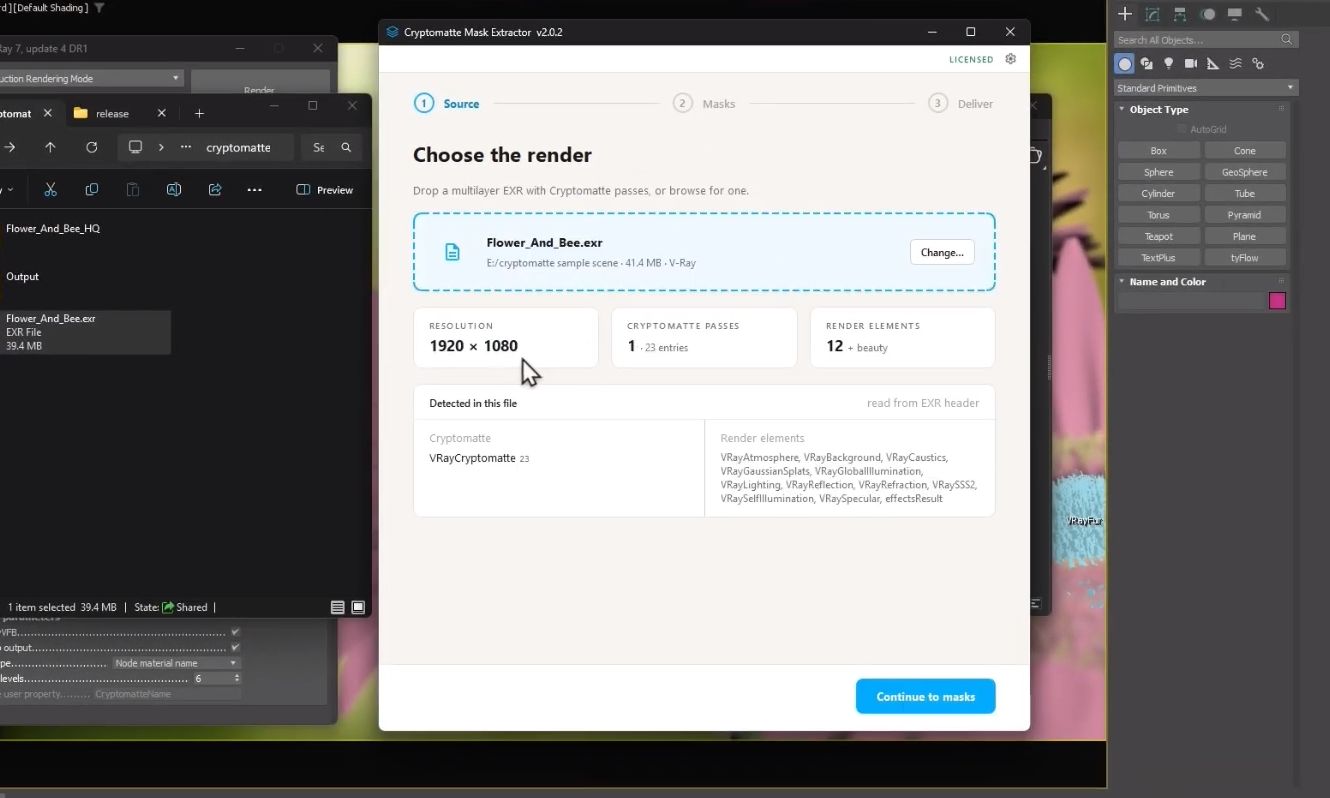
CryptomatteExtractor turns Cryptomatte passes into layered PSDs
CGPress · cgpress.org ↗
CryptomatteExtractor is a utility that streamlines one of the more tedious steps in compositing: pulling usable, isolated masks out of Cryptomatte passes stored in multi-layer EXR files. Cryptomatte is a widely used system for generating object, material, or asset ID mattes during rendering, but working with those passes traditionally requires compositor know-how and several manual steps. With a single click, CryptomatteExtractor converts those passes into a layered PSD file, giving artists clean, named selection masks they can bring straight into Photoshop or other layer-based applications. This kind of tool is especially useful for motion graphics artists and compositors who need to hand off renders for finishing work in Photoshop-based pipelines. By removing the technical friction around EXR handling, it makes Cryptomatte's powerful masking capabilities accessible to a wider range of users.

Free 100+ PBR Materials (Scans)
BlenderNation · blendernation.com ↗
A collection of over 100 high-quality PBR material scans is now available for free download under a royalty-free license, courtesy of Balint Barlai. Physically based rendering materials derived from real-world scans are among the most sought-after assets in 3D production, typically commanding premium prices or subscription fees on major asset platforms. What sets this release apart is its friction-free accessibility — no account creation, no sign-up, and no paywalls stand between artists and the full library. Users can browse, select, and download whatever they need directly. For indie developers, archviz artists, game designers, and hobbyists working on tight budgets, a curated scan-based PBR library of this size, offered outright and without strings, is a genuinely useful resource.

Google bets Gemini can turn casual players into game developers with new Playground feature
Manuel Uth · the-decoder.com ↗
Google has launched Playground, a browser-based game creation platform that lets anyone build playable games using natural language text prompts, with zero coding required. The platform is powered by Google's Gemini AI alongside Nano Banana and the Lyria music generation model, suggesting that it can handle not just game logic and visuals but potentially audio as well. The ambition is clear: democratize game development by collapsing the distance between an idea and a playable prototype, turning casual players into creators. Alongside the consumer-facing Playground, Google and Unity jointly announced Unity Spark, a more professionally oriented AI development tool aimed at experienced developers, with a beta window slated for 2026. Together, the two initiatives signal a coordinated push by Google and its partners to embed AI across the full spectrum of game development, from bedroom hobbyist to studio professional.

Google says 180 billion images and videos now carry SynthID watermarks as detector goes public
Manuel Uth · the-decoder.com ↗
Google has made its SynthID AI watermarking detector publicly accessible, allowing anyone to check whether an image, video, or audio file carries a SynthID watermark embedded by Google's AI systems or participating partners including OpenAI and Nvidia. The scale of adoption is striking — Google reports that more than 180 billion pieces of content already carry SynthID watermarks, a figure that underscores how widely the standard has been deployed across major generative AI platforms. The public detector represents a meaningful step toward AI content transparency, giving journalists, researchers, and everyday users a concrete tool to verify provenance. However, there is an important limitation worth noting: the detector only identifies content that has been tagged with SynthID specifically, and will not flag AI-generated media produced by systems that use different or no watermarking schemes. As a result, it functions more as a verification tool for participating ecosystems than a universal AI content detector.